

Bsc It Applied Mathematics 2 Pdf
Inside the Mathematics Institute. (Credit: Alain Goriely) 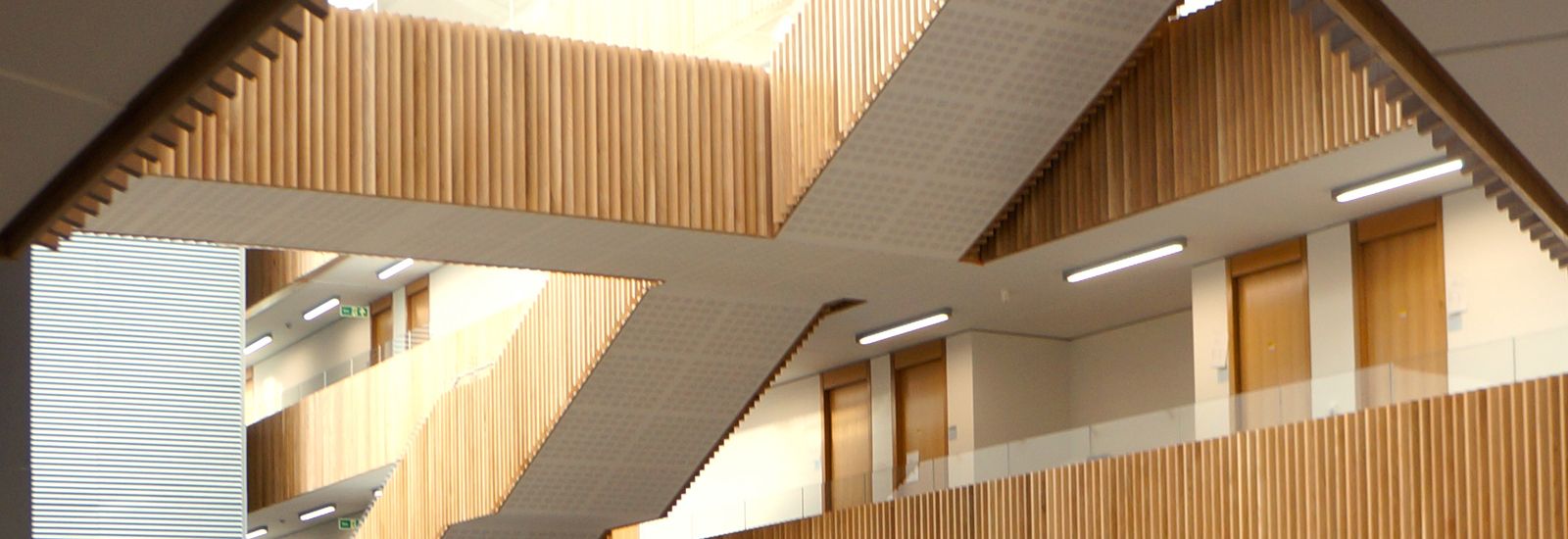
Share This
Mathematics
- Overview
- Structure
- Admissions Requirements
- Careers
- Fees and Funding
- Studying at Oxford
3 years (BA) A*A*A with the A*s in Maths and Further Maths if taken Interviewed: 34% +44 (0)1865 273586 Unistats information for this course can be found at the bottom of the page

UCAS code G100 
Duration
4 years (MMath) 
Entrance requirements 
Subject requirements Maths
Further Maths 
Admissions test(s) ox.ac.uk/mat 
Written work None 
Admissions statistics*
Successful: 11%
Intake: 186
*3-year average 2018-20 
Contact
Email Maths
Please note that we are currently working from home. Please email where possible.
Mathematicians have always been fascinated by numbers. One of the most famous problems is Fermat's Last Theorem: if n≥3, the equation xn+yn=znhas no solutions with x, y, z all nonzero integers. An older problem is to show that one cannot construct a line of length3√2 with ruler and compass, starting with a unit length.
Often the solution to a problem will require you to think outside its original framing. This is true here, and while you will see the second problem solved in your course, the first is far too deep and was famously solved by Andrew Wiles.
In applied mathematics we use mathematics to explain phenomena that occur in the real world. You can learn how a leopard gets its spots, explore quantum theory and relativity, or study the mathematics of stock markets.
We will encourage you to ask questions and find solutions for yourself. We will begin by teaching you careful definitions so that you can construct theorems and proofs. Above all, mathematics is a logical subject, and you will need to think mathematically, arguing clearly and concisely as you solve problems. For some of you, this way of thinking or solving problems will be your goal. Others will want to see what else can be discovered. Either way, it is a subject to be enjoyed.
There are two Mathematics degrees, the three-year BA and the four-year MMath. Decisions regarding continuation to the fourth year do not have to be made until the third year. The first year consists of core courses in pure and applied mathematics (including statistics). Options start in the second year, with the third and fourth years offering a large variety of courses, including options from outside mathematics.
A typical week (Years 1 and 2)
- Around ten lectures and two-three tutorials or classes a week
- Additional practicals in computing (first year) and numerical analysis (if taken)
A typical week (Years 3 and 4)
- Six-ten lectures and two-four classes each week, depending on options taken
- Compulsory dissertation in the fourth year
Tutorials are usually 2-4 students and a tutor. Class sizes may vary depending on the options you choose. There would usually be around 8-12 students though classes for some of the more popular papers may be larger. Most tutorials, classes, and lectures are delivered by staff who are tutors in their subject. Many are world-leading experts with years of experience in teaching and research. Some teaching may also be delivered by postgraduate students who are usually studying at doctorate level. To find out more about how our teaching year is structured, visit our Academic Year page.
Course structure
There are two Mathematics degrees, the three-year BA and the four-year MMath. Decisions regarding continuation to the fourth year do not have to be made until the third year. The first year consists of core courses in pure and applied mathematics (including statistics). Options start in the second year, with the third and fourth years offering a large variety of courses, including options from outside mathematics.
| YEAR 1 | |
| COURSES Compulsory Year 1 includes:
| ASSESSMENT First University examinations: five compulsory papers; Computational mathematics projects |
| YEAR 2 | |
| COURSES
| ASSESSMENT Final University examinations, Part A: three core papers and six or seven optional papers |
| YEARS 3 AND 4 | |
| COURSES
The options listed above are illustrative and may change. A full list of current options is available on the Maths website. | ASSESSMENT Year 3: Final University examinations, Part B: eight papers or equivalent Year 4: Final University examinations, Part C: eight, nine or ten papers or equivalent, including a dissertation Classification on Parts A and B: currently a 2:1 over Parts A and B, as well as a 2:1 in Part B alone, is required to progress to Part C. |
MMathPhys Year 4
The Physics and Mathematics Departments jointly offer an integrated master's level course in Mathematical and Theoretical Physics. Mathematics students are able to apply for transfer to a fourth year studying entirely mathematical and theoretical physics, completing their degree with an MMathPhys. The course offers research-level training in: Particle physics, Condensed matter physics, Astrophysics, Plasma physics and Continuous media.
mmathphys.physics.ox.ac.uk
Academic requirements
| A-levels: | A*A*A with the A*s in Mathematics and Further Mathematics (if taken). For those whom Further Mathematics is not available: either A*AAa with A* in Mathematics and a in AS-level Further Mathematics or A*AA with A* in Mathematics. |
| Advanced Highers: | AA/AAB |
| IB: | 39 (including core points) with 766 at HL (the 7 must be in Higher Level Mathematics) |
| Or any other equivalent (see other UK qualifications, and international qualifications) | |
Wherever possible, your grades are considered in the context in which they have been achieved. (See further information on how we use contextual data.)
Subject requirements
| Essential: | Candidates are expected to have Mathematics to A-level (A* grade), Advanced Higher (A grade), Higher Level in the IB (score 7) or another equivalent. |
| Recommended: | Further Mathematics is highly recommended. |
The majority of those who read Mathematics will have taken both Mathematics and Further Mathematics at A-level (or the equivalent). However, Further Mathematics at A-level is not essential. It is far more important that you have the drive and desire to understand the subject. Our courses have limited formal prerequisites, so it is the experience rather than outright knowledge which needs to be made up. If you gain a place under these circumstances, your college will normally recommend suitable extra preparatory reading for the summer before you start your course.
While AEA and STEP papers are not part of our entry requirements, we encourage applicants to take these or similar extension material, if they are available.
Applying
All candidates must follow the application procedure as shown in applying to Oxford. The information below gives specific details for students applying for this course.
Admissions test
| Test: | MAT |
| Test date: | 3 November 2021 |
| Registration deadline: | 6pm 15 October 2021 |
All candidates must take the Mathematics Admissions Test (MAT) as part of their application. Separate registration for this test is required and it is the responsibility of the candidate to ensure that they are registered. We strongly recommend making the arrangements in plenty of time before the deadline. Everything you need to know, including guidance on how to prepare, can be found on the MAT page.
Written work
You do not need to submit any written work when you apply for this course.
What are tutors looking for?
Tutors are looking for a candidate's potential to succeed on the course. We recommend that candidates challenge themselves with Mathematics beyond their curriculum, question their own understanding, and take advantage of any available extension material. Ultimately, we are most interested in a candidate's potential to think imaginatively, deeply and in a structured manner about the patterns of mathematics. For more detail on the selection criteria for this course, please see the Maths Department website.
Careers
Quantitative skills are highly valued, and this degree prepares students for employment in a wide variety of occupations in the public and private sectors. Around 30% of our graduates go on to further study, but for those who go into a profession, typical careers include finance, consultancy and IT.
Nathan, an engineer, says: 'During my degree I developed my ability to solve complex problems – a fundamental skill set to tackle challenges I encounter on a day-to-day basis as an engineer. The application of mathematics in engineering and manufacturing is ever increasing, meaning there will be more and more opportunities to find interesting roles in which I can apply my skills.'
Fees
Additional Fees and Charges Information for Mathematics
There are no compulsory costs for this course beyond the fees shown above and your living costs.
Bsc It Applied Mathematics 2 Pdf
Source: https://www.ox.ac.uk/admissions/undergraduate/courses-listing/mathematics
Posted by: spurrining1960.blogspot.com
0 Response to "Bsc It Applied Mathematics 2 Pdf"
Post a Comment